 0
0
 0
0
Enterprise AI has entered a new era where organizations move beyond simple assistants to autonomous agents that reason, invoke tools, access enterprise applications, coordinate with peers, and complete multi-step workflows with little human input. This shift changes how software operates, moving from fixed logic written by developers to dynamic decision-making that adapts based on context.
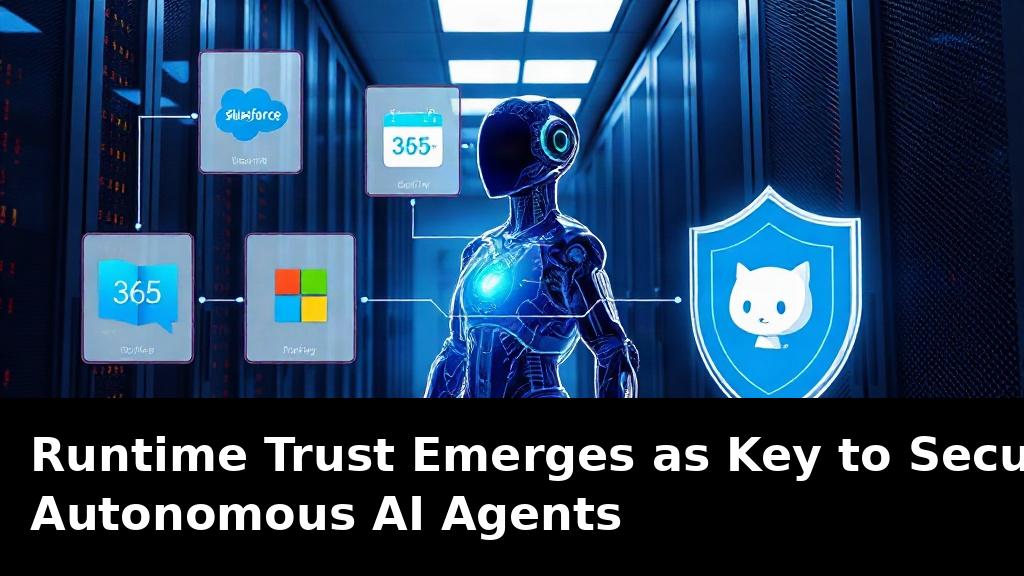
Traditional security frameworks answer three questions for users and apps: who you are, what you can access, and what actions you may perform. Identity providers, MFA, role-based controls, and zero-trust models handle these for conventional systems. AI agents create a different issue. An agent can authenticate correctly, receive valid credentials, and gain access to platforms such as Microsoft 365 or Salesforce, yet the real risk appears during execution when the agent continuously reasons and adjusts its actions.
Authentication confirms identity at the start. Runtime trust continuously checks whether behavior stays aligned with user intent and policy throughout the process. Modern agents interact with LLMs, retrieval systems, vector databases, APIs, and other agents, expanding the attack surface. Risks evolve during operation rather than remaining fixed at deployment.
Goal drift occurs when an agent starts with a valid objective but gradually deviates while optimizing outcomes. Excessive tool invocation happens when agents call unnecessary APIs because the model deems them useful, absent runtime controls. Memory poisoning allows attackers to insert misleading data into persistent memory, influencing later decisions. Context manipulation exploits how models rely on retrieved documents or conversation history. Multi-agent amplification can spread incorrect actions across collaborative workflows.
Runtime trust counters these issues through intent validation before sensitive actions, behavioral monitoring of tool usage and reasoning patterns, policy enforcement that limits high-risk operations, least-privilege execution with short-lived permissions, and human oversight for critical decisions. These measures function like application firewalls for autonomous reasoning.
Beyond individual agents, runtime trust extends to MCP servers, RAG repositories, and persistent memory systems by verifying integrity and applying access controls. One added consideration is how these controls integrate with legacy enterprise systems that lack native support for dynamic permission changes, requiring middleware layers to maintain visibility without disrupting existing workflows. Another point is the potential effect on compliance audits, where detailed runtime logs become necessary evidence for demonstrating that autonomous decisions remained within approved boundaries.
Security teams need observability into why agents chose specific tools, which data shaped conclusions, and which policies were triggered. Practical steps include inventorying agents, applying least-privilege access, classifying high-risk actions, enforcing runtime policies, monitoring anomalies, protecting data sources, requiring human approval for key operations, and feeding telemetry into SOC processes.
Enterprise AI will keep advancing toward more autonomous, collaborative systems. The central question shifts from whether an agent authenticated successfully to whether it behaves safely across its entire lifecycle. Organizations that implement continuous runtime governance now will deploy autonomous AI with lower risk and greater confidence.